Saturday, July 25, 2015

GIDEON'S ARMY
 
And the Lord said to Gideon, “The people who are with you are too many for Me to give the Midianites into their hands, lest Israel claim glory for itself against Me, saying, ‘My own hand has saved me.’
 
Judges 7:2

After the time of the Judge Deborah, the people of Israel once more 'did evil in the sight of God' and He gave them over to the Midianites for seven years. The Midianites lived in the lands to the east of the Gulf of Aqaba, which today is in Saudi Arabia. The Midianites, together with the Amalekites and others from the East, constantly raided Israel, taking their grain and livestock, causing great suffering, until the Israelites, in desperation, called out to God. In response God raised up a Judge called Gideon, the least son of the least clan of the half-tribe of Manasseh. There came a time when the Midianites, with their allies from the East, raised up a vast army, of at least 135,000 fighting men  (Judges 8:11), and they camped  in the Jezreel Valley below the Hill of Moreh.


https://ferrelljenkins.files.wordpress.com/2011/01/harod_map-sm.jpg
 
Gideon also raised up an army and camped opposite the Midianites at Ein Harod (The Spring of Harod).


Ein Harod and Mt Moreh today https://lukechandler.files.wordpress.com/2009/07/dscf0160.jpg?w=640


Gideon's army was vastly outnumbered since it consisted of only 32,000 men, about a quarter the size of the Midianite hordes!
Now the Midianites and Amalekites, all the people of the East, were lying in the valley as numerous as locusts; and their camels were without number, as the sand by the seashore in multitude
Judges 7:12
 
What chance did Israel have against so great an enemy? And yet, God said Gideon's army were too many, and He commanded Gideon to send all but 300 home. Why? It must have seemed crazy, but God intended to fight for Israel and He wanted to be sure that they, and all their enemies, would know that it was He who would give Israel victory. He would demonstrate His power and his love for Israel in a way that all could see, and in a way that would make it impossible for the people to take the glory for themselves. And He did. With God's help Gideon's tiny army succeeded in driving the Midianite hordes from the Land and the people of Israel enjoyed peace for 40 years.
 
Today Israel is surrounded by a great many enemies, some of whom have vast armies, far outnumbering ours. According to the Global Firepower Index, Iran alone has an  army of around 2 million soldiers currently in front-line service or in active reserves, and another 40 million fit for duty if needed (http://www.globalfirepower.com/country-military-strength-detail.asp?country_id=iran). Add to that the armies of all the other enemies of Israel and you will see we are vastly outnumbered and that is an understatement.  Israel has only about 700,000 soldiers in active or reserve duty, and perhaps another around 3 million fit for duty at a pinch. What chance would we have if all our enemies attacked together now?
 
This week a Commission headed by Maj.-Gen. (res.) Yohanan Locker published its report that recommends the IDF (Israel Defense Force) budget be cut by 9.6 billion shekels each year over the next 4 years.  These 'efficiency' cuts would include a reduction of 11 % of the army's resources and personnel by 2017,  and cutting back the length of compulsory service and reserve duties, among other measures. It seems crazy considering the massive military threat Israel currently faces - just as crazy as Gideon's cuts. But perhaps God is preparing the stage, for yet another spectacular demonstration of his power and love for Israel. I remember the saying 'Me plus God is a majority'. Its true. As long as God is for us who can be against us? (Romans 8:31).
 
In that day the Lord will defend the inhabitants of Jerusalem; the one who is feeble among them in that day shall be like David, and the house of David shall be like God, like the Angel of the Lord before them. It shall be in that day that I will seek to destroy all the nations that come against Jerusalem.
Zechariah 12: 8-9

For the day of the Lord upon all the nations is near;
As you have done, it shall be done to you;
Your reprisal shall return upon your own head.
16 For as you drank on My holy mountain,
So shall all the nations drink continually;
Yes, they shall drink, and swallow,
And they shall be as though they had never been.

17 “But on Mount Zion there shall be deliverance,
And there shall be holiness;
The house of Jacob shall possess their possessions.
18 The house of Jacob shall be a fire,
And the house of Joseph a flame;
But the house of Esau shall be stubble;
They shall kindle them and devour them,
And no survivor shall remain of the house of Esau,”
For the Lord has spoken.
Obadiah v. 18

 
Although we know that in the end, the God of Israel will triumph and destroy all those who rise up against his holy people, I fear this will not happen until the people themselves cry out for salvation and rescue. The LORD is bringing Israel back to her land, but most are returning in a state of unbelief. We are all aware of the threats hanging over us but most are living in a state of denial with an 'eat, drink and be merry' attitude, instead of  repentance. Since the foundation of the State there have been many wars and confrontations with our neighbors and in each one God has clearly intervened to save many lives and to give Israel, though vastly outnumbered, the victory. There are many, many reports of miraculous events that support this view. I have noticed that as long as the fighting is going on, the newspapers and the people do give recognition to the hand of the LORD and his supernatural protection, but as soon as the fighting stops, everyone forgets, gives glory to the IDF and our own strength, and then everything goes back to normal. We forget so quickly the goodness of the LORD.  
 
There are many parallels between our times and the time when the remnant of  Judah under the leadership of Ezra and Nehemiah returned to Jerusalem from Babylon, and rebuilt the Temple and the walls around the city.  They too had to hold a weapon in one hand and build with the other, for their neighbors lead by Tobias, Sanballat and Geshem the Arab, fought against them. Even so, it took them, under the leadership of Nehemiah, only 52 days to completely repair the entire city wall which the Babylonians had totally destroyed.  And their enemies were astounded:
 
   And it happened, when all our enemies heard of it, and all the nations around us saw these things, that they were very disheartened in their own eyes; for they perceived that this work was done by our God.
Nehemiah 6:16
 
Once the work was complete, all the people, in the seventh month gathered together and Nehemiah read to them the Book of the Law, and when they heard its words, and realized their sin, they wept. That year the whole people kept the Feast of Tabernacles with joy, but when it was over they gathered together with fasting, wearing sackcloth and with ashes on their heads, confessing and repenting of their sin. They then entered into a solemn curse and an oath "to walk in God’s Law, which was given by Moses the servant of God, and to observe and do all the commandments of the Lord our Lord, and His ordinances and His statutes"(Nehemiah 10:29). Later, at the dedication of the wall, all the people rejoiced with great joy before God:
Also that day they offered great sacrifices, and rejoiced, for God had made them rejoice with great joy; the women and the children also rejoiced, so that the joy of Jerusalem was heard afar off.
Nehemiah 12: 43.  
 
Yet, what happened?  Nehemiah had to return to Babylon for a time, and the minute his back was turned, the people permitted their erstwhile enemy, Tobias, to set up his household in the Temple itself, corrupting the priesthood and the sacrifices, and all the people turned away from the commandments of God, profaning the Sabbath. How short our memory! However Nehemiah returned, worked to restore the proper functioning of the priesthood, and eventually cleansed the Land of all pagan worship. (Nehemiah 13:30).

What will it take to convict the people of Israel today of their sin and bring them to repentance? Today the nations are gathering around against Jerusalem, and the stage is being set for a mighty battle that Israel's little army could never win. When all hope of victory will be lost, then the people will cry out and God will step in and bring victory, as is prophesied in Jeremiah 12  and elsewhere. God will save Israel and he will destroy her enemies. Zion will see victory, Israel will be restored, not only physically but also spiritually.  All Israel will be saved and they will know their Messiah  (Romans 11:26). Hallelujah!


 And what else is happening in Israel this summer?
 
This week the first intake of the year of new draftees into the IDF took place. At least 43 young Messianic believers will be in this year's draft, and I believe there are currently  around 300 believers serving in the IDF. Please remember to pray for these young men and women who face a lot of challenges, not the least that of being separated from family and congregation, whilst being subjected to a great degree of peer pressure to conform to the behavior and beliefs of their comrades. In spite of this many of our wonderful young people have been recognized as outstanding soldiers and most stand firm in their faith shining as a light to their peers.


High summer is now upon us and the children are on vacation. The heat out on my balcony has just driven me indoors for the relative cool of my apartment (the indoor thermometer is reading 30 degrees!), even though it is just 9AM. We cannot complain however as the summer has not been particularly hot up until now, and the low humidity (about 30%) here on our mountain keeps the heat bearable. Only one year ago, Operation Tsuk Eitan was in progress in Gaza, and  our poor soldiers were sweating it out in army fatigues, sleeping  in the dust, behind their tanks, and risking their lives every  minute. The civilians in the south were crammed into  sweltering bomb shelters as the sirens blared warning of incoming rockets and missiles, sometimes as many as 12 times a day.
 
One day this week I took myself off to the lovely swimming pool at Ramat Rachel nearby.  As I arrived at the pool, I was thinking how great it was to be able to swim,  and relax on the lawns under the trees, without having to worry about where I would have to run to if the sirens went off. Just at that very moment, the siren went off!!!! I had to laugh at the irony. Everyone stopped and a ripple of shock passed through us all until the head lifeguard called to us that it was just an exercise. Even so in the midst of the blaring noise, which went on some minutes, there was an eerie silence. Everyone stopped, no one talked or walked or swam. We just stood there. I know my stomach twisted as it always does when the sirens go. I was probably not alone and I am sure we all shared the same thoughts, remembering last summer, and knowing that the threat of war is hovering over us all the time. It was a harsh reminder that the calm and joy of our summer vacation could be cut short any moment. Later that same day, in the evening, our neighborhood peace was rent by the sound of several large explosions nearby, followed by gunfire and hovering helicopters (a sure sign that something is amiss). I never did learn what happened but since then we have been hearing sporadic gunfire in the Arab villages across the valley.  This is not unusual and sometimes it is just a wedding celebration or some other event at which is it customary in Arab society to shoot off guns (forgetting that bullets fired into the air, must come down somewhere!). However it had been quiet for several months since the police cracked down on the disturbances earlier in the year. I hope that this does not mark a return to the sporadic explosions and volleys  of gunfire we used to have almost daily.

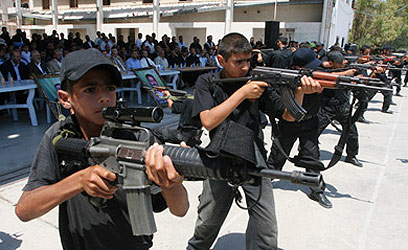
Many of Israel's children are currently enjoying summer camps. All over Israel you can see groups of happy, laughing children having the time of their lives, playing games, touring the Land, and swimming. But what about the kids in Gaza? There the kids are going to 'summer camp' too, but the goal of these Hamas-run camps is "to train the vanguard for liberation: spiritually, intellectually and physically, to be ready and able to play its role in liberation," according to a statement by the Izz ad-Din al-Qassam Brigades, Hamas' military wing. http://www.ynetnews.com/articles/0,7340,L-4683772,00.html This  year's 'summer camp' accepts people from the ages of 15 to 60, and 25,000 are attending, mostly youngsters.  They are  being taught how to fire live ammunition (using portraits of Israeli leaders for targets) and how to infiltrate and carry out attacks through terror tunnels, hand-to-hand combat and other military skills. Worse still, they are being indoctrinated and brainwashed into a culture of hatred and violence.  


Israeli youngsters enjoying summer camp
http://www.tshcamp.com/wp-content/gallery/daycamp2/740x420_swim.jpg


 Gazan children show off their skills at their 'summer camp' - with real guns..
http://www.ynet.co.il/PicServer2/24012010/2688381/k1_wa.jpg

Where is the outcry of the human rights groups about this abuse and  the brutalization of a whole generation of children? How is it that Hamas has money for this but not to rebuild homes destroyed in the war they started last year? Perhaps those 25,000 young people would have been better employed rebuilding those parts of Gaza destroyed in last year's war, or learning the skills needed to build a better future for themselves and their people?
 
Another feature of Israeli summers are forest and brush fires. Yesterday two large fires broke out. One, in the Galilee, was brought under control quickly, but another near Beit Shemesh burned out of control for many hours. This was the biggest fire since the catastrophic fire on the Carmel in 2010 in which 40 people perished. Thankfully since that time our fire fighting capability has improved, not the least by the acquisition of at least 13 planes that can drop fire retardant. With the help of 150 firefighters and volunteers, and the planes, the villages of  Tarum, Kfar Uriya and Ta'oz  were saved and there was no loss of life. Nevertheless 370 acres of wooded land were burned.
 
There is an especially high fire risk in the pine forests around Jerusalem. High temperatures, strong winds,  combined with pine resins and  a lot of dead branches brought down by the snow over the last years,  all creates a volatile mix. Just a piece of glass in the sunshine is enough to ignite a fire which can spread very quickly. The fire near Beit Shemesh yesterday is thought to have started when an (illegal) rubbish fire got out of control, but over the past years many fires have been lit by arsonists as acts of terrorism.


Photo: Beit Shemesh Fire and Rescue
 
 
Photo: Beit Shemesh Fire and Rescue  
 
 
 I have only two weeks left of my summer vacation and then  it will be back to work. I plan to enjoy every moment . However please join me in lifting up the people of Israel at this time. Tension and stress levels run high. Many people go abroad during the summer for a time of rest and to visit relatives. When here we just get on with life and mostly are not so aware of the stress levels, but when you go out of the Land it is as if a heavy burden is lifted, and you realize how much tension you have been under.  But then you must come home and for many re-entry is difficult.  Please remember us all in your prayers. They are important and God hears them all.


Monday, July 20, 2015


HEAR MY PRAYER
 
Hear my prayer, O Lord,
And let my cry come to You.
Do not hide Your face from me in the day of my trouble;
Incline Your ear to me;
In the day that I call, answer me speedily.
For my days are consumed like smoke,
And my bones are burned like a hearth...
My enemies reproach me all day long;...
 
12 But You, O Lord, shall endure forever,
And the remembrance of Your name to all generations.
13 You will arise and have mercy on Zion;
For the time to favor her,
Yes, the set time, has come.
14 For Your servants take pleasure in her stones,
And show favor to her dust.

15 So the nations shall fear the name of the Lord,
And all the kings of the earth Your glory.
16 For the Lord shall build up Zion;
He shall appear in His glory.

17 He shall regard the prayer of the destitute,
And shall not despise their prayer...
 
 
Psalm 102
 
A deceptive quiet lies over Jerusalem and the whole of Israel  at this time, as during the day we tend to hide indoors to escape the summer heat ,or relax at the pool, coming out only in the delightful cool of the evening to stroll, make barbecues with our friends and drink coffee at the cafes. The children are on vacation and many families have gone abroad to visit family or just escape the pressures of life in Israel.
 
How to keep cool in Jerusalem in summer
http://www.jerusalemfoundation.org/media/87403/Jerusalem-Summer-Fun-in-Teddy-Park_500x375.jpg
 
Yet the quiet is an illusion. This week it has been 'business as usual' in Jerusalem and elsewhere in Israel.  On Wednesday a 22 year old Palestinian  woman attempted to kill an IDF soldier by stabbing him in the back at  a military post in the West Bank. The soldier was taken to hospital with light-to-moderate wounds (http://www.ynetnews.com/articles/0,7340,L-4680288,00.html). 
 
At 2 AM on Thursday morning residents of the Ashkelon region scrambled out of bed, grabbed the kids and the dog, and fled to their 'safe rooms' as the code red sirens sounded warning of an incoming medium-range missile  fired from the Gaza Strip. Fortunately it landed in an open field causing no damage or injuries. Later that same morning the Israeli Air Force bombed an infrastructure site in Gaza in retaliation. One passerby was lightly injured. This is just the latest of a number of such attacks in recent weeks. There were six such incidents in the month of June alone https://en.wikipedia.org/wiki/List_of_Palestinian_rocket_attacks_on_Israel,_2015 .  In addition, on Friday the 3rd of July, three rockets were fired from the Sinai and two landed in Israel near Eilat, causing no damage or injuries.  An Islamic State affiliated group claimed responsibility. http://www.aljazeera.com/news/2015/07/isil-affiliate-sinai-claims-rocket-attack-israel-150703192810233.html These rocket attacks are not primarily designed to antagonize Israel, but to destabilize the Egyptian regime in the Sinai and the Hamas regime in Gaza, and to promote the power and ideology of the Islamic State (formerly ISIS). Already by last November polls in Gaza showed that some 24% of the population supports the Islamic State either totally or 'to some extent'. http://unitedwithisrael.org/poll-palestinians-greatest-supporters-of-isis-in-middle-east-2/?ios_app=true
 
This week we also learned of two Israelis being held in Gaza. One, a young man of Ethiopian descent, Avera Mengistu, 28, climbed over the fence and entered the Gaza Strip via the adjacent Zikim Beach shortly after the ceasefire with Hamas in September last year. Mengistu is known to the authorities as suffering from psychological issues and is possibly mentally challenged. He may have been drinking when he crossed into Gaza. Whatever the truth he was captured and questioned by Hamas who claim they released him once they ascertained that he was not a soldier. His current whereabouts is unknown, but Israeli officials believe that Hamas is holding him and a second missing Israeli citizen, an unnamed Bedouin Arab, who for unknown reasons also crossed into Gaza. The fear is that these two prisoners, along with the bodies of two soldiers captured during Operation Cast Lead last year, will be used by Hamas to attempt to broker another prisoner exchange, something Israel has already said it will not countenance.
 
A photograph Avera Mengistu, 28, from his Facebook page.
A photo of Mengistu from his facebook page
http://www.haaretz.com/news/diplomacy-defense/1.663653
 
The big news this week of course is the Iran deal. After 20 months of negotiations the P5+1 group of nations ( the US, UK, France, China and Russia plus Germany)  and Iran have come to an agreement, the Joint Comprehensive Plan of Action (JCPOA),  aimed at scaling down Iran's nuclear capability and easing economic sanctions against it. 
 

The Negotiating Team
http://www.economist.com/blogs/economist-explains/2015/07/economist-explains-11
Iran has three uranium mines and the ore from these must be enriched before it can be used. Natural uranium consists of two isotopes U-235 and U-238. Only U-235 can be used for fueling power stations or for making nuclear warheads or bombs. Natural uranium is only about 0.711% U-235.  For fuel purposes the uranium must be enriched so that it is about 3-4% U-235, and for a warhead or bomb it must be enriched to 90%. Enrichment is done by feeding uranium hexafluoride gas into centrifuges and spinning it so that the heavier U-238 sinks to the bottom and the lighter U-235 rises. It can then be separated out. There are currently two enrichment facilities operating, the main one at Natanz and another at Fordo.
 
null

http://www.bbc.com/news/world-middle-east-33521655
 
With this background let us look more closely at the JCPOA deal. There are 8 main points:
 
  • At present Iran has 19,500 centrifuges at their main enrichment facility at Natanz. Under the new agreement only 5060 of these, will be allowed to operate over the next 10 years, and these will all be first-generation centrifuges, which can only produce low-enriched uranium suitable for fueling power stations and for medical, agricultural, industrial and scientific purposes.  
  • At the second enrichment facility, at Fordo, all enrichment will cease and no enriched uranium will be produced for at least 15 years. The facility will be turned into a physics research center.
  • Iran's current stockpile of low-enriched uranium (which could potentially be spun into weapons-grade material) must be reduced 98%, from 9,000 kg to 300 kg for the next 15 years.
  • The heavy-water reactor at Arak will be redesigned and its original core, which would have produced significant quantities of weapons-grade plutonium, will be removed and destroyed. No other heavy-water reactor will be built for 15 years.
  • Inspectors from the IAEA (International Atomic Energy Agency) will be able to inspect any facility, declared or otherwise, as long as it is deemed to be “suspicious”.
  • If Iran refuses access to a military site, a joint commission made up of representatives of the parties to the agreement will quickly rule on whether it must open the facility up. If it still refuses, Iran would then be in violation of the agreement and might face the re-imposition of sanctions.
  • The IAEA will also have access to every part of Iran’s nuclear supply chain to ensure that nothing is being channeled to a clandestine facility. Such powers for the IAEA, which will remain in place indefinitely, are more sweeping than those it had under the normal safeguard agreements that had previously applied to Iran under the NPT.
  • Iran will address the IAEA’s concerns about what it calls the Possible Military Dimensions of its nuclear program.
 

Is this a 'good deal'? Will it hold? Will the deal be ratified and implemented by all nations concerned? Can Iran be trusted, given its past track record and continued threats against Israel and the USA? Is the IAEA really able to monitor what Iran is doing in its large, mountainous country? Does the world have the will to re-impose sanctions should Iran fail to keep its word? What will happen after the 10 - 15 years are up? These are all questions that only time will tell and history will judge.
 
Perhaps the Deal will buy us a little time, if it can be implemented and enforced ( and that is a big 'if'). But then what?  At the end of the 10 year period Iran will have a legitimate right under international law to reactivate its centrifuges and rebuild its enriched uranium stockpiles. They already boast that they can have as many as 190,000 centrifuges up and running within weeks and, in the same time frame, quickly produce nuclear warheads to load onto the missiles they are continuing to buy from Russia and are producing themselves on a large scale, missiles capable of reaching targets in the Middle East, Europe and even the USA. The Deal does not address Iran's conventional weapon development and proliferation. Nor does it address the risk of a nuclear arms race in the Middle East. Other Middle Eastern states are already saying that if Iran is allowed to produce nuclear weapons they too must do so.
 
Furthermore, even with the current sanctions imposed against it ,Iran is managing to fund, train and arm many terror organizations including  the Taliban in Pakistan, Hezbollah in Lebanon, Hamas in Gaza and the West Bank, Islamic Jihad in Iraq, Gaza and elsewhere, and the Houthis currently overrunning Yemen. The US State department considers Iran the world's most active state sponsor of terrorism, and former Secretary of State, Condoleeza Rice described it as " the country that has been in many ways a kind of central banker for terrorism".  http://www.cfr.org/iran/state-sponsors-iran/p9362 .  Under the Deal, Iran will receive at least $US100 billion when sanctions are lifted. Even if it does not channel this money directly into terrorist organizations, an economically stronger Iran will be able to pour even more money into funding terrorism, which is directed at destroying the US and Western influence  worldwide (the 'Big Satan') and Israel (the "Little Satan) . The Deal does not address this issue in any way. No wonder the Iranian delegate to the P5+1 negotiations, Mohammad Javad Zarif, the Iranian foreign minister, went home with a smile on his faces (more a Freudian slip than a typo!).  And Kerry prayed....


http://i.telegraph.co.uk/multimedia/archive/03249/kerry-zarif_3249914b.jpg
 
And a  worried Netanyahu prayed too....
 
http://s1.ibtimes.com/sites/www.ibtimes.com/files/styles/v2_article_large/public/2015/04/05/netanyahu-iran.JPG
So what can we do? What is our responsibility in all of these things as believers in the Messiah, Yeshua (Jesus)? In my last post I wrote of our responsibility as a 'kingdom of priests'. What is the role of a priest? There are many functions and I will write more about that another time, but one of the main functions is as an intercessor - a 'go-between' between God and the people.  First and foremost we must pray about all these things. God is working out his redemption plan and we need to be working alongside and with Him. This begs the question, "How must we pray?" It is hard to know sometimes, but we can always pray in the Spirit with sighs deeper than words, and allow the Holy Spirit in us to interpret these cries. And God hears our cries. They are effective and they matter. By our prayers we participate in the  working out of the redemption of the world. As I quoted from Psalm 102 verse 17 above,  
He shall regard the prayer of the destitute,And shall not despise their prayer...
We are often 'destitute' as we pray, in that we do not have the understanding to know how to pray, nor the power to change anything ourselves, but the LORD will not despise our prayers . They are a pleasing incense rising to the Him (Revelation 5:8).  He will work it all out and one day, perhaps not so very far in the future, we will see all the nations bowing down to Him - Iran, Israel, the USA and every nation of the Earth. 

Behold, He is coming with clouds, and every eye will see Him, even they who pierced Him. And all the tribes of the earth will mourn because of Him.
Even so, Amen.
 
Revelation 1: 17

Sunday, July 12, 2015


A ROYAL PRIESTHOOD
 
 
To Him who loved us and washed us from our sins in His own blood, and has made us kings  and priests to His God and Father, to Him be glory and dominion forever and ever. Amen.
 
Revelation 1: 5-6
 
 
I have just returned home after a short holiday in the Forest of Dean in the lovely, green hills of the west of England. Leaving the lush, fertile fields and  leafy forests of England, with its mild and well-watered climate, I couldn't help but wonder why God did not choose that blessed land in which to establish his holy people. Flying into Tel Aviv at sunset, with the shimmering heat haze mixing with the pollution to cast a golden glow across the brown, sere summer landscape the contrast could not have been greater. And yet it was good to be home. In my absence high summer has settled upon the land. School is out, many have flown abroad to visit relatives and find relief from the stresses of life in Jerusalem, the tourists braving the heat are few, the Ramadan fast lies on the Muslim population, and the city has a certain air of somnolence about it. All seems peaceful but, of course, this is just an illusion (and a bit of wishful thinking), for the tensions in the city are no less in reality. Terror attacks continue on an almost daily basis, Iran continues to play games with the West while building up its nuclear and military potential, and funding and supplying arms to Hezbollah and Hamas, our sworn-enemies to the north and south. The Islamic State creeps inexorably closer through Syria and Egypt, and its toxic ideology gains ground in the hope-starved youth of the region, even within our own borders. With so many threats around and within our little nation, any semblance of peace can be nothing more than the lull before the storm.
 
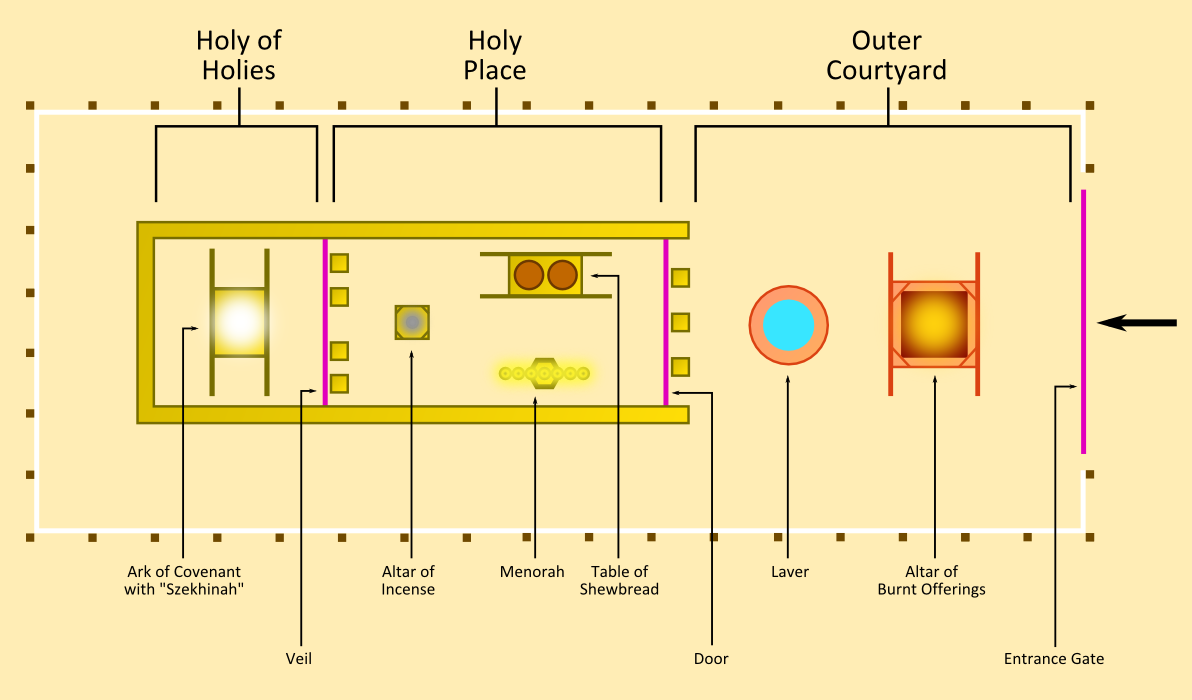
And I am reminded of the fact that we, who believe in Yeshua (Jesus) have a calling, one we don't think about very much, and that is the calling of a priest. Evangelical Christians shy away from ideas of a priesthood, so we tend to ignore or be unaware of this calling, yet John writing to the churches of Asia, as recorded for all of us in the Book of Revelation describes us as a 'kingdom of priests' (or in some versions, kings and priests) (see quotation above).  It is true that we as believers do not need priests to act as intermediaries between us and God, as in former times. At the moment when Yeshua died on the cross, the veil of partition between the Holy of Holies and the Holy Place, where the ordinary priests served, was rent from top to bottom, something only God could have done  (Matthew 27:51). This proclaimed the fact that we, as ordinary priests, now have direct access to God by the Holy Spirit in Yeshua. We no longer need priests to intercede for us, and we have a Great High Priest, Yeshua, who has offered the only true sacrifice for our sins, his own blood, and who intercedes for us continuously in heaven. The wall between the Holy Place and the Outer Courtyard, the place of the common people,  was not destroyed however. Those who are not of the priesthood, those who as yet are unsaved, still do not have access to God. They still need priests to act as intermediaries and intercessors.

Plan of the Mosaic Tabernacle
http://blog.try-god.org/wp-content/uploads/2014/07/tabernacle.png

The Tabernacle of Moses is long gone and the Aaronic priesthood, and the sacrificial system were destroyed two thousand years ago when the Romans conquered Jerusalem and destroyed the Temple. These things have never been restored to this day. So how is it we are described as a kingdom of priests? In what way are we to function as priests today?
 
There is much I could say about the Aaronic Priesthood and the Tabernacle, its design and its symbolism. The writer to the Hebrews described the Mosaic Tabernacle as the 'copy and shadow' of the 'heavenly things' (Hebrews 8:5). Every aspect of the Tabernacle was designed and spelled out in detail by the LORD himself, and is full of deep symbolism and relevance for us today. The Tabernacle foreshadows the Kingdom of God in its fullness under the High Priesthood of Yeshua (Hebrews 9). The other day I was reading in the book of Exodus chapter 28 God's instructions to Moses about the garments of the High Priest.
 
Some things stood out for me as I read this passage;
They shall take the gold, blue, purple, and scarlet thread, and the fine linen, and they shall make the ephod of gold, blue, purple, and scarlet thread, and fine woven linen, artistically worked... (verses 5 and 6)
 Then you shall take two onyx stones and engrave on them the names of the sons of Israel: 10 six of their names on one stone and six names on the other stone, in order of their birth. 11 With the work of an engraver in stone, like the engravings of a signet, you shall engrave the two stones with the names of the sons of Israel. You shall set them in settings of gold. 12 And you shall put the two stones on the shoulders of the ephod as memorial stones for the sons of Israel. So Aaron shall bear their names before the Lord on his two shoulders as a memorial. (verses 9-12)
 You shall make the breastplate of judgment. Artistically woven according to the workmanship of the ephod you shall make it: of gold, blue, purple, and scarlet thread, and fine woven linen, you shall make it... (verse 15)
 And the stones shall have the names of the sons of Israel, twelve according to their names, like the engravings of a signet, each one with its own name; they shall be according to the twelve tribes.... (verse 21)
  So Aaron shall bear the names of the sons of Israel on the breastplate of judgment over his heart, when he goes into the holy place, as a memorial before the Lord continually. 30 And you shall put in the breastplate of judgment the Urim and the Thummim, and they shall be over Aaron’s heart when he goes in before the Lord. So Aaron shall bear the judgment of the children of Israel over his heart before the Lord continually. (verses 29-30).
http://www.messianic-torah-truth-seeker.org/Torah/Kohen/kohen-garments.jpg

Thus it was whenever the High Priest donned his ceremonial garments he bore before God the names of the 12 tribes of Israel, once on his shoulders as a memorial before God, and once on the breastplate of judgment, close to his heart. So too today, our Great High Priest, Yeshua, still bears the names of the tribes of Israel on his shoulders and close to his heart as He intercedes on our behalf, and we too, the kingdom of priests, need to do the same.

This is the calling of intercession. There are some who have a special callings and gifting as intercessors, but we are all called to intercede for Israel, and indeed for all the Gentile nations as well, for their salvation.

This week I also read these words in Psalm 147,
The Lord builds up Jerusalem;
He gathers together the outcasts of Israel.
He heals the brokenhearted
And binds up their wounds...
 Praise the Lord, O Jerusalem!
Praise your God, O Zion!
13 For He has strengthened the bars of your gates;
He has blessed your children within you.
14 He makes peace in your borders,
And fills you with the finest wheat...
 
 
He sends out His command to the earth;
His word runs very swiftly.
16 He gives snow like wool;
He scatters the frost like ashes;
17 He casts out His hail like morsels;
Who can stand before His cold?
18 He sends out His word and melts them;
He causes His wind to blow, and the waters flow.
19 He declares His word to Jacob,
His statutes and His judgments to Israel.
20 He has not dealt thus with any nation;
And as for His judgments, they have not known them.
Praise the Lord!

 God's word is swift and powerful, and nothing can stand against it.  He declared his Word to Israel, to her prophets and priests, and the Word, Yeshua, came to Israel. The LORD has not dealt so with any other nation. Furthermore, He has not yet finished with Israel. He is even in our day gathering her outcasts back to the Holy Land,  and binding up their wounds. One day He will reveal Himself to them in Yeshua, the Messiah. We need to be participants in God's work in our day. We need to be interceding in prayer faithfully for the people of Israel, together with all the Gentiles, who are as yet unsaved. When Yeshua comes again, and this may be very soon, He will be revealed in glory as the Messiah, and all the peoples of the Earth will weep before him., even 'those who pierced him',
Behold, He is coming with clouds, and every eye will see Him, even they who pierced Him. And all the tribes of the earth will mourn because of Him. Even so, Amen.
Revelation 1: 7 
 
https://s-media-cache-ak0.pinimg.com/236x/9d/3a/08/9d3a0848f416974a9ae66afda63d20d8.jpg


Sunday, June 21, 2015


OCCUPATION?
 
The earth is the Lord’s, and all its fullness,
The world and those who dwell therein...
Psalm 24:1
 
Last week I wrote about the threat of the BDS (Boycott, Divestment and Sanctions) Movement to Israel.  There are those who claim that it is not the threat of BDS we should be focusing on but rather Israel's settlement policy and the  'occupation' of the West Bank (Samaria and Judea). In recent times the BDS movement itself has been focusing on this issue to gain support, even though their aims are not merely to get Israel to leave these areas, but to establish Palestinian rule from the Jordan River to the Mediterranean, in other words, to completely destroy the State of Israel.
 
The 'occupation' and the settlements are a topic of hot debate in Israel, and criticism of these policies are a legitimate part of the democratic process. The issues however are extremely complex and solutions to the problems difficult to find.
 
The bottom line however is that, as I quoted above, the whole earth, and all that is in it, belong to the LORD. We are all temporary settlers and occupiers of the lands in which we dwell. We live in them only by the grace of God. It is He who raises up kings and rulers, and governs the nations and the peoples. As the prophet Daniel spoke to King Nebuchadnezzar of Babylon,
 
 "the Most High rules in the kingdom of men,
Gives it to whomever He will"...
Daniel 4:17
 
 Similarly Yeshua (Jesus) said to Pilate,
You could have no power at all against Me unless it had been given you from above."
John 19:11.
 
 
The only nation to whom the LORD promised a particular area of land on this Earth, in perpetuity, is the nation of Israel. He first made this promise to Abraham,
 
Get out of your country,
From your family
And from your father’s house,
To a land that I will show you.


So they came to the land of Canaan.   Abram passed through the land to the place of Shechem, as far as the terebinth tree of Moreh. And the Canaanites were then in the land.

 Then the Lord appeared to Abram and said, “To your descendants I will give this land.


Genesis 12: 1, 6-7
 

Later, after Abram's period in Egypt, he came to the mountains of Israel and stood between Bethel and Ai, and the LORD again spoke to Abram and said,


Lift your eyes now and look from the place where you are – northward, southward, eastward and westward; for all the land which you see I will give to you and your descendants forever.


And I will make your descendants as the dust of the earth; so that if a man could number the dust of the earth, then your descendants also could be numbered.


Arise, walk in the land through its length and its width for I give it to you
(Genesis 13:14-17).
 
Note here that the emphasis is on the land that God would give Abram and his descendants forever. God’s promises to Abram and his descendants are not airy-fairy things but down-to-earth practical and real. The land and the people, and their calling as the chosen nation, are all inextricably tied together.
 
And God confirmed this when he made a solemn covenant with Abram saying,
To your descendants I have given this land, from the river of Egypt to the great river, the River Euphrates...
Genesis 15: 18
 
This too is the first time the precise boundaries of the Promised Land are defined and they stretch from the River of Egypt in the south and to the River Euphrates in the north. The River of Egypt was traditionally understood to be the easternmost branch of the Nile River delta, the Pelusian arm of the Nile (1). Pelusium was a border town of Egypt. This means that the whole of the Sinai Peninsula would have been included in the Promised Land. More recent commentators suggest that the River of Egypt is what is now known as Wadi Arish (2), which lies some 60km from the southern border of the Gaza Strip today. This confusion may have come about because the Pelusian arm of the Nile no longer exists. It became choked with sand as early as the first century BC (3). The Wadi Arish interpretation would exclude the Sinai Peninsula from the Promised Land of Israel. However Wadi Arish is a ‘wadi’ (in Arabic) or ‘nahal’ (in Hebrew), a term denoting a watercourse that dries up in the summer months - one that flows only intermittently. The word used in the Bible is ‘nahar’, meaning a river that flows all the time. This would seem to count against the Wadi Arish interpretation. During the reign of King David, Israel controlled the area from the River of Egypt and the Gulf of Aquaba (on the Red Sea) in the south to the Euphrates River in the north (4). 

                   https://upload.wikimedia.org/wikipedia/commons/thumb/3/3f/Davids-kingdom.jpg/400px-Davids-kingdom.jpg
And God confirmed the granting of this area to Israel when he made a solemn covenant with Abram saying,
To your descendants I have given this land, from the river of Egypt to the great river, the River Euphrates...
Genesis 15: 18
 
When Abram was 99 years old the LORD appeared to him again, renamed him Abraham,   confirmed his covenant with him and said,
 
Also I give to you and your descendants after you the land in which you are a stranger, all the land of Canaan, as an everlasting possession; and I will be their God.”
Genesis 17: 8
 
 
It is interesting to note, that in spite of the promises God made to Abraham regarding the Land, Abram did not seize it by might or aggression, but acted humbly and lawfully towards the inhabitants of the land. The only land he ever actually owned was Sarah's grave site 


When Abraham's beloved wife, Sarah, died Abraham was living in Kiriat Arba (Hebron) amongst the Canaanites. Owning no land of his own, he went to the leaders of the city and asked them to sell him the cave of Machpelah for Sarah's burial;
 
If it is your wish that I bury my dead out of my sight, hear me, and meet with Ephron the son of Zohar for me, that he may give me the cave of Machpelah which he has, which is at the end of his field. Let him give it to me at the full price, as property for a burial place among you...So the field of Ephron which was in Machpelah, which was before Mamre, the field and the cave which was in it, and all the trees that were in the field, which were within all the surrounding borders, were deeded 18 to Abraham as a possession in the presence of the sons of Heth, before all who went in at the gate of his city.

Genesis 23:  8-9, 17-18


God also confirmed His covenant with Abram's heirs, Isaac and Jacob (Genesis 26: 2-5, and Genesis 28: 13-15), but the people of Israel did not truly take possession of the Land until they returned from Egypt, crossed the Jordan and conquered it under the leadership of Joshua.
 
You might  ask however, if God had given the Land of Israel to the descendants of Abraham for an everlasting possession, then what of the periods in which Israel was exiled from the Land?  Though theirs by covenant, Israel's occupation of the land and the enjoyment of its fruits, was always conditional upon their obedience to God. In Leviticus 26 God promises to bless the Land and give it peace from its enemies as long as the people walk in His statutes and keep His commandments, but He also said...


if you do not obey Me, but walk contrary to Me,

28 then I also will walk contrary to you in fury...

 
I will scatter you among the nations and draw out a sword after you;

your land shall be desolate and your cities waste.

Leviticus 26 27-28, 33.


And so it was that during the time of the divided kingdom of Israel and Judah all the people fell into worshipping the false gods of the surrounding peoples, even to the extent that they burned their babies alive to the image of the terrible god, Moloch.  What a horrendous abomination! How could God allow it to go on? He couldn't. God therefore brought calamity upon them in the form of the invading armies of the Assyrians and the Babylonians, and most of the population (not all) were expelled from the Promised Land and scattered throughout the nations of the world.
 
Yet, even as God had promised to scatter them among the nations, he also promised to bring them back when they repented of their evil.
‘But if they confess their iniquity and the iniquity of their fathers, with their unfaithfulness in which they were unfaithful to Me, and that they also have walked contrary to Me,
41 and that I also have walked contrary to them and have brought them into the land of their enemies;
if their uncircumcised hearts are humbled, and they accept their guilt—
42 then I will remember My covenant with Jacob, and My covenant with Isaac and My covenant with Abraham I will remember;
I will remember the land...
44 Yet for all that, when they are in the land of their enemies, I will not cast them away, nor shall I abhor them, to utterly destroy them and break My covenant with them;
for I am the Lord their God.
45 But for their sake I will remember the covenant of their ancestors, whom I brought out of the land of Egypt in the sight of the nations, that I might be their God:
I am the Lord.
Leviticus 26: 40- 45


And so it was, after 70 years had passed, the LORD brought a remnant of the people of Israel  back to the Land, though many of those scattered have remained amongst the nations to this day. The remnant, mostly of the former kingdom of Judah and a small number from the kingdom of Israel, rebuilt the Land and lived there until the time of Yeshua, but then they rejected Him bringing upon their heads exile once more. In the year 70 AD they were expelled again from the Land, this time by the Romans. This ushered in the Times of the Gentiles when the gospel was taken out to all the world, a period lasting almost 2000 years. But even this  second exile was not to be forever. Again God promised he would bring them back to the Land and this time, he would bring them back while they were still unrepentant, but  once in the Land, He would bring them to their knees before their enemies and only then would Yeshua be revealed and they would repent. (for more on this see my posting entitled "Dry Bones").

After the destruction of the Temple the Romans attempted to wipe out all Jewish influence and so renamed Jerusalem Aolia Capitolina, and the Land, Palaestina. Around 330 CE the Roman Emperor converted to Christianity and the Byzantine Empire ruled the Eastern Mediterranean lands, including 'Palestine'. In the year 632 AD, the Muslims captured Jerusalem and Palestine and Jews were permitted to return to Palestine. Muslim rule continued for nearly 400 years until the Crusaders invaded, massacring many Jews in the process.  The Crusaders ruled for around 100 years until the Muslims regained control in 1187 AD. The last of the Crusaders left in 1291AD. From then until 1917 Palestine was under Muslim Rule (5).
 

 A remnant population of Jews continued to live on in the Land  throughout all the centuries, mainly in Jerusalem, Hebron, and Safad (Sfat). At the time of the Crusades in the 11th Century AD at least 50 Jewish communities  were known, including in Jerusalem,  Tiberias, Ramleh, Ashkelon, Caesarea and Gaza (6)  In 1516, during the time of the Ottoman rule, 'as many as 15, 000 Jews lived in Safad alone and Jerusalem was a predominantly Jewish city.  At this time the Muslims of Jerusalem 'scarcely exceed[ed] one quarter of the whole population' , according to the British Consul of the time (7).
 
And so it was that at the beginning of the 19th Century CE (AD) the Land of Israel lay desolate, an almost empty, poverty stricken backwater of the Syrian Province of the Ottoman Empire. The total population of the Land prior to the first wave of Jewish immigration was thought to be around half a million (8). Mark Twain, in 1867, described it thus
"There is not a solitary village throughout its (the Jezreel Valley) whole extent - not for thirty miles in either direction. There are two or three small clusters of Bedouin tents, but not a single permanent habitation. One may ride ten miles hereabouts and not see ten human beings ... (in reference to the Galilee) these unpeopled deserts, these rusty mounds of barrenness, that never, never, never do shake the glare from their harsh outlines, and fade and faint into vague perspective; that melancholy ruin of Capernaum; this stupid village of Tiberias, slumbering under its six funereal palms... We reached Tabor safely ... We never saw a human being on the whole route. ...Nazareth is forlorn... Jericho the accursed lies in a moldering ruin ... Bethlehem and Bethany, in their poverty and their humiliation.... Bethsaida and Chorzin have vanished from the earth, and the "desert places" around them ... sleep in the hush of a solitude that is inhabited only by birds of prey and skulking foxes" (9)

 
An 1857 communique from the British Consulate in Jerusalem reported that " the country is in a considerable degree empty of inhabitants and therefore its greatest need is that of a body of population" (10). Alan Dershowitz in his book "The Case for Israel"  (5 p. 27) notes,
The myth of a stable and settled Palestinian-Arab-Muslim population that had lived in villages and worked the land for centuries, only to be displaced by the Zionist invaders, is simply inconsistent with the recorded demographic data gathered not by the Jews or Zionists, but rather by the local authorities themselves.
Prior to the 1880s, the population of the Land was dwindling as a result of poverty, disease and migration. In 1861 it was reported that "depopulation is even now advancing' (11) and in 1866 that in certain parts of the country land was going out of cultivation and whole villages are rapidly disappearing" (12)

So it was, fleeing the persecutions and anti-Semitism of Europe, the first modern Jewish settlers arrived in Israel during the 1880s.  They did not seize the land for settlement by force but purchased it from the owners, in the main absentee landlords, for an agreed price. The land thus purchased was often considered uninhabitable  and had been abandoned by its owners. As the Jewish settlements got established, they drained the malarial swamps, irrigated the fields, improved healthcare and provided jobs, and this in turn caused encouraged a flood of Arab immigrants into the area.  For example, the settlement of Rishon L'Tzion, of 40 Jewish families attracted more than 400 Arab families into the area, where they established a new village on an abandoned ruin (13). Alan Dershovitz  (5 p. 28) concluded that
... it is beyond reasonable dispute - based on census figures, authoritative reports, eyewitness accounts, and simple arithmetic - that the myth of the displacement by the European Jewish refugees of a large, stable, long-term Muslim population that had lived in that part of Palestine for centuries is demonstrably false.

In the following years several more waves of Jewish refugees from Europe came and settled in the Land and, by the time of the 1917 Balfour Declaration, the area was occupied by a mosaic of Jewish and Arab settlements.  The Balfour Declaration stated that

His Majesty's Government view with favour the establishment in Palestine of a national home for the Jewish people, and will use their best endeavours to facilitate the achievement of this object, it being clearly understood that nothing shall be done which may prejudice the civil and religious rights of existing non-Jewish communities in Palestine, or the rights and political status enjoyed by Jews in any other country (14).
Who were these other Arabic speaking inhabitants of the land? For a clear discussion of this question see the link below:


Some facts emerge:

  • At the time of the first Zionist waves of immigration the Land was scarcely populated, mainly by poor, tenant farmers and nomadic Bedouin, and this population was dwindling,
  • The Jews did not occupy the land by force, but bought  land, often at extortionate prices, from absentee Arab landlords, who willingly sold it,
  • The land bought by Jews was often the poorest quality land, such as the malarial swamps of the coastal plain and Hulah Valley,
  • The economic success of the new Jewish settlements drew in many Arabs from the surrounding lands attracted by jobs, better sanitation and medical services.


There was no Palestinian people. Although some individuals may have been descended from families living in the land for hundreds of years, the vast majority were newcomers.

During the First World War the Ottoman Empire sided with Germany and  in 1917 the British allies captured Jerusalem and all of Palestine fell under British rule. In the same year, British Foreign Minister Arthur Balfour issued the "Balfour Declaration" promising to establish a Jewish State in the land of Palestine. From 1917 until the end of the Second World War hundred of thousands of Jewish refugees from Europe, many of whom were Holocaust survivors, immigrated to the Land. The Arabs carried out several revolts against British rule and the changing demographic. The worst was the 1936 Revolt which lasted 3 years.

Following the Second World War Britain handed over the question of the Land to the United Nations which devised a Partition Plan to divide the area into two nations, one Jewish and one Arab. Jerusalem was to remain under international control.  Reluctantly the Jewish leadership accepted the plan but the Arabs of Palestine and the other Arab nations rejected it.


https://upload.wikimedia.org/wikipedia/commons/thumb/d/db/UN_Partition_Plan_For_Palestine_1947.svg/2000px-UN_Partition_Plan_For_Palestine_1947.svg.png

On November 29, 1947, the UN General Assembly accepted the Partition Plan with  33  votes in favor to 13 against. On May 14th, 1948 the British mandate formally ended and the declaration of the modern state of Israel was proclaimed. The very next day  a confederation of Egypt, Jordan and Syria together with expeditionary forces of Iraq attacked the tiny fledgling State. When an armistice was signed 10 months later, Israel had not only retained all the area allotted to it by the Partition Plan but had conquered 50% of that allotted to the Arabs, and west Jerusalem, and Jordan had occupied the West Bank and Egypt had occupied the Gaza Strip. It is strange we hear very little about that occupation of Palestinian lands!
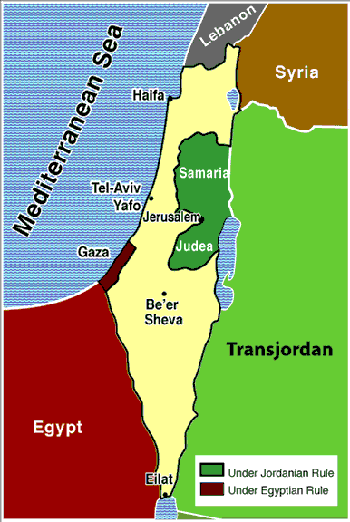


https://www.jewishvirtuallibrary.org/jsource/images/maps/1949linesnick.gif

During the course of the 1948 war, about 750,000 Arabs fled or were driven (it depends who you talk to) from their homes and became refugees in Lebanon, Syria and Jordan. These refugees were not assimilated into those countries and about one third of them and their descendants, now numbering about 1.5 million, live in United Nations (UNWRA) run refugee camps to this day. Less well known is the fact that at the same time, a roughly similar number of Jews were expelled from Arab countries and many settled in Israel where they successfully integrated into the general population.

In the years following there were a series of wars, all initiated by the Palestinian Arabs and their supporters and  these resulted in more land being conquered by Israel. In 1967 Israel launched a preemptive strike against the gathering forces of Egypt, Syria and Jordan. In the war that followed Israel conquered the Sinai Peninsula, the West Bank, East Jerusalem and the Old City, and the Golan Heights.


http://www.mfa.gov.il/MFA_Graphics/MFA%20Gallery/Documents/map%20story%20part1.pdf

Was it legitimate that Israel occupied these conquered lands? I believe so. I believe that when any people or nation embarks upon the course of warfare with its neighbors it forfeits its rights should it lose that war. It has been so since the dawn of human existence and so it is in every part of the world today. Every nation that exists today occupies its land by right of conquest. Why should Israel be different?

Nevertheless, bowing to international pressure, Israel has since 1967 relinquished control of both the Sinai Peninsula and the Gaza Strip. What has been the result? The Sinai Peninsula, neglected by Egyptian government, has degenerated into a 'no man's land' ruled and terrorized by terrorist groups which launch attacks on Egyptian interests and Israel. The Gaza Strip has fallen into the hands of Hamas, a Salafist terrorist organization, and even worse, is falling more and more under the influence of the so-called Islamic State (ISIS). What would happen if Israel were to relinquish control on the West Bank? Would the fate of its inhabitants be any different than those of the Sinai or Gaza? Israel cannot risk having the West Bank fall under the hegemony of Hamas or IS.

All this begs the question of the occupation. I would like to raise the question " Who is occupying whose land?" The Bible is clear, the Land from the River of Egypt to the Euphrates was unequivocally given to the people of Israel for an everlasting inheritance. But what of the Arabs who live there?  I believe that the Bible is clear on this point too. When strangers in the land chose the LORD God of Israel, and abide by His law, they have a place in the Land.

Thus you shall divide this land among yourselves according to the tribes of Israel. 22 It shall be that you will divide it by lot as an inheritance for yourselves, and for the strangers who dwell among you and who bear children among you. They shall be to you as native-born among the children of Israel; they shall have an inheritance with you among the tribes of Israel. 23 And it shall be that in whatever tribe the stranger dwells, there you shall give him his inheritance,” says the Lord God.
         Ezekiel 47: 21-23

 It should be noted that the word here translated 'stranger' is in Hebrew 'ger', which literally means immigrant. There is much debate about the precise meaning of this word in the Bible; does it merely mean a resident alien or does it mean a convert?  In the ancient pagan world gods were linked to geographic areas and therefore it was usual for any immigrant to adopt the gods of the people with whom he lived.  Consequently it would probably have been understood that anyone who chose to live in the Land of Israel would necessarily worship the God of Israel. It was so for Ruth who in accompanying her mother-in-law returning to the Land of Israel, she gave up her Moabite gods and chose the God of Israel. God blessed her, gave her and her descendants, an inheritance in the land, and she became the grandmother of King David and a forebear of Yeshua (Jesus), the Messiah. So it was too for all the 'mixed multitude' of Egyptians who chose to flee Pharaoh with the Israelites at the time of the Exodus (Exodus 12: 38). They chose the God of Israel and were incorporated into the people of Israel.  As it says in Psalm 2,
Now therefore, be wise, O kings;
Be instructed, you judges of the earth.
Serve the Lord with fear,
And rejoice with trembling.
Kiss the Son, lest He be angry,
And you perish in the way,
When His wrath is kindled but a little.
Blessed are all those who put their trust in Him
                                                                 Psalm 2: 10-12.

Within the borders of Israel today many Arab residents own lands and enjoy the full rights of citizens. They enjoy a general standard of living much higher than anywhere in the Arabic speaking world, and equal standing under the law of the land.  There is no apartheid. I live and work with Arabs, we use the same shops, we travel in the same buses and stand in the same long lines in government offices.

So what of the settlements? Do Israelis have the right to settle in the West Bank and East Jerusalem? One of the most serious accusations against Israel is that it seizes privately owned Palestinian land. If this is so, it would not only be illegal but immoral.  On the other hand,  if the land is purchased fairly and according to the law from willing owners, then why not? But is it? The issue of land ownership is incredibly complex in this region. There are three legal systems under which land ownership is registered - the Ottoman, the British and the modern Israeli system. Large tracts of unoccupied land was gifted to villages and tribes during the period of Jordanian occupation. None of this land was purchased, most never used, no taxes were paid and the original recipients now dead. According to both the Ottoman and British Mandate law, gifted land could not be inherited without approval by the sovereign, and land that was given by the sovereign could be claimed as private only if the land was used continually (usufruct) for 10 years and taxes were paid.Unused land reverts to the sovereign by law. Jordan changed this law and registered the land as privately owned, permanently, without conditions, but since Jordan was never acknowledged as the legitimate sovereign over this territory, its laws have no validity (16). So whose land is it?

The bottom line is as I began, the land is the LORD's and he will dispose of it according to His will, and he promised it to Israel. Are the settlements lawful and morally defensible? There is no easy answer to that. Are they God's will for Israel at this time of history? That is another question and I think only time and history will provide the answer.

Whatever the truth in all this, one thing is sure, it is much more complicated than the simplistic claims of the BDS movement and their supporters. Nothing in this  region is black and white. Below I have printed in full an article from Ynetnews which provides arguments with which to counter the claims of the BDS movement. 


  1. http://en.wikipedia.org/wiki/Brook_of_Egypt
  2. ibid
  3. http://en.wikipedia.org/wiki/Pelusium
  4. http://www.bible-history.com/map-davids-kingdom/map-davids-kingdom_near_east.html
  5. http://www.questionsaboutislam.com/history-of-islam/history-palestinian-israeli-conflict.php?print=1
  6. Katz, Shmuel. Battleground: Fact and Fantasy in Palestine. Taylor Productions Ltd., 1974 (ISBN 0-929093-13-5), pg. 97
  7. James Finn to the Earl of Clarendon,  January 1, 1858 in Albert Hyamson, The British Consulate in Jerusalem (London: Jewish Historical Society, 1941)
  8. Dershowitz, Alan " The Case for Israel"  2003 John Wiley and Sons
      
  9.  Twain, Mark "The Innocents Abroad" Oxford University Press, NY, 1996 pp. 485,508,520,607-608.
  10. James Finn to the Earl of Clarendon, September 15, 1857  in Albert Hyamson, The British Consulate in Jerusalem (London: Jewish Historical Society, 1941)
  11. J.B.Forsyth. A Few Months in the East (Quebec; J Lovell 1861)
  12. H.B. Tristram The Land of Israel: A Journey of Travels in Palestine (London: Society for Promoting Christian Knowledge, 1866)
  13. A. Druyanov Ketavim Letoldot Hibbat Zion v' Yeshuv Eretz Yisrael ( Tel Aviv 1919, 1925, 1932 vol 3 pp 66-67)
  14. http://www.mfa.gov.il/mfa/foreignpolicy/peace/guide/pages/the%20balfour%20declaration.aspx
  15. Dershowitz, Alan " The Case for Israel"  2003 John Wiley and Sons  p. 27
  16. http://www.jpost.com/Opinion/Is-Israel-stealing-private-Palestinian-land-385917


http://www.ynetnews.com/articles/0,7340,L-4665412,00.html

Exposing the lies of BDS


Op-ed: Many a good person has fallen for the persuasive arguments of the boycott campaign, which appears to be driven by respect for human rights. But the truth is far more nefarious.
Published: 06.07.15, 10:31 / Israel Opinion


The "Fighting the Boycott" campaign launched by Ynet's sister publication, Yedioth Ahronoth, has sparked numerous reactions and questions – some challenging and significant.


      They attest to the challenges posed by the BDS movement. The questioners are not anti-Semites. A portion of the BDS supporters are falling under the spell of the movement because it purports to be tackling a real problem.


      Yes, the Muslims and Arabs are killing Arabs and Muslims as a matter of routine, and far more than any operation by Israel – and it's only intensifying. But the focus on Israel, some critics of the country argue, stems from the fact that Israel is a democracy. There are other questions and issues too – concerning the occupation, human rights, the settlements, the blockade, and more.


      And look, says the man on the fence to himself, the occupation has been around for decades, and there's no peace and no hope. So perhaps the non-violent approach offered by the boycott campaign is in fact the right way?

      BDS demonstration in Melbourne, Australia, 2010 (Photo: Reuters)
      BDS demonstration in Melbourne, Australia, 2010 (Photo: Reuters)


      Let's try to answer some of these questions – because they represent the questions of many a good man and woman who are being sucked into the rhetoric of the BDS campaign not out of hatred for Israel or anti-Semitism, but because they truly believe in human rights, non-violence and fixing the world. They deserve answers.


      Perhaps the problem is the occupation and not the BDS campaign?


      This appears to be the most widespread argument among those who understand, explain and justify the boycott. Omar Barghouti, a leader of the BDS campaign, was once asked: Will an end to the occupation also bring an end to the campaign? "No," he replied bluntly.

      More importantly, the BDS campaign wasn't suspended even for a moment when Ehud Olmert and Tzipi Livni spoke for Israel. They actually wanted to end the occupation. It didn't work out for them.


      BDS Movement
      It's time for an Israeli counterattack against BDS lies  / Noah Klieger
      Op-ed: Israel must finally wake up and stop letting its enemies win on the propaganda front.
      Read full op-ed
      Would an agreement with the Palestinians silence the BDS movement?


      On the contrary. The initiators and leaders of the campaign are opposed to a peace settlement based on two states for two peoples. Their guiding principle is the so-called right of return, which would mean an end to Israel; and one of their main slogans reads: "From the river to the sea, Palestine will be free."

      Thus, we need to find a compromise, and we need to fight for a settlement and peace – and that's exactly we also need to oppose the boycott campaign.


      Perhaps the BDS campaign is intensifying because Israel has rejected the peace proposals?


      In early 2001, Yasser Arafat went to the White House and turned down Bill Clinton's peace proposal. In 2008, Mahmoud Abbas rejected a similar proposal from Ehud Olmert. And in March 2014, Abbas again said no – this time, to a proposal drafted by US Secretary of State John Kerry. Therefore, even if the lie about Israeli rejectionism is repeated a thousand times, it still remains a lie.

      Perhaps the fact that Israel continues to build settlements is proof that it doesn't want peace?


      The settlement enterprise is the focus of intense public debate within Israel. Not every piece of criticism aimed at Israel is demonization; and criticism of the settlement enterprise is certainly not demonization.

      In any event, the construction in the West Bank, for the most part, is taking place inside the existing settlement blocs, which even under Clinton's proposal will remain in Israeli hands. Justified criticism is one thing, but support for BDS is a different story altogether.


      Egyptian campaign to boycott Orange for its operations beyond the Green Line
      Egyptian campaign to boycott Orange for its operations beyond the Green Line


      Perhaps it's worth trying the non-violent BDS approach in light of the failed diplomatic efforts and armed struggles?


      A campaign led by people who deny Israel's right to exist cannot hide under a blanket of "a non-violent campaign." Negating Israel's right to exist is "politicide," political annihilation, a blatant violation of international law. We're not dealing with a fight for rights, but a fight rather to single out and deny one particular nation's right to self-determination.

      Perhaps international pressure is a legitimate means to achieve political goals?


      International pressure is a legitimate tool. Therefore, and as unpleasant as it may be, the European Union has every right to pressure Israel vis-à-vis the settlements, to mark products and the like. But don't get things mixed up.

      There's a big difference between international pressure designed to promote a peace settlement and the BDS campaign, the stated aim of which is to oppose any peace arrangement based on two states for two peoples.


      Just because Iran and North Korea violate human rights, does that mean Israel can do so too?


      Violating human rights is unjust, regardless of the national or religious identity of the state. The problem is that while dozens of countries are involved in conflicts and human rights violations, an international campaign is being waged almost exclusively against just one country – Israel.

      Hypocrisy isn't morality. Double standards aren't standards. The criticism aimed against Israel isn't criticism; it's racism.


      And what about the blockade on Gaza?


      Israel pulled out of the Gaza Strip. It didn't want a blockade. The blockade isn't against the residents of the Strip; it's against the supreme effort on the part of Hamas to acquire weapons. A flourishing and prosperous Gaza Strip is in Israel's interests. The BDS movement and Hamas have other interests at heart.

      There are many more questions; and some of the claims against Israel are indeed justified. Feel free to ask anything you like. The dialogue has just begun. To be continued.