THE MORNING AFTER
O Israel, trust in the Lord;
He is their help and their shield.
O house of Aaron, trust in the Lord;
He is their help and their shield.
You who fear the Lord, trust in the Lord;
He is their help and their shield.
The Lord has been mindful of us;
He will bless us;
He will bless the house of Israel;
He will bless the house of Aaron.
He will bless those who fear the Lord,
Both small and great.
Psalm 113: 9-13
It is a beautiful Shabbat morning and the sun is shining out of a clear blue sky after a week of rainy and overcast weather. We will have a few more days of sunshine before the next rain system arrives. The cycle of the weather in Israel at this time seems to parallel the security situation.
After a botched intelligence-gathering incursion into Gaza on Sunday night, and the consequent killing of an Israeli officer and 7 Hamas gunmen, including a high ranking Hamas official, Hamas fired some 460 rockets into Israel over a 25 hour period, the highest bombardment we have ever suffered in such a short period ever. Israel responded by attacking 160 Hamas military targets, until Hamas called for a ceasefire and Israel agreed.
The ceasefire has now lasted for over 3 days but the situation is tense. The uneasy quiet could be shattered any moment and the feeling is that the next round could be catastrophic, both for Israel and for Gaza.
The ceasefire has now lasted for over 3 days but the situation is tense. The uneasy quiet could be shattered any moment and the feeling is that the next round could be catastrophic, both for Israel and for Gaza.
During the bombardment, the Iron Dome system shot down around 100 rockets bound for residential areas and most of the others fell in open ground. A large number of failed rockets also fell within Gazan territory.
Some tens of rockets and mortars, however, did fall within Israeli towns and villages in the Gaza Perimeter area causing one death, around 100 injuries and much damage to property. A new kind of missile punched a hole in a 4th-floor apartment in a building in Ashkelon, damaging all the apartments in the building. As a result, one man was killed, a Palestinian worker from Hebron who was illegally staying overnight in an apartment in Ashkelon. The woman he was with was seriously injured. A number of other residents were also injured.
A Jewish soldier is still fighting for his life, but improving, after being hit by shrapnel from an antitank shell that hit a bus that just moments before had brought around 50 soldiers to an assembly point near the Gaza border. The bus driver was also seriously injured in the attack. A video of the attack has been posted on the internet showing the bus unloading the soldiers and then pulling into a parking area as the shell hit. The soldier seriously injured just happened to be standing nearby as the shell hit the back of the bus. (https://www.youtube.com/watch?v=F0u3V8LyD08) Look at the video and you will see that it is a miracle this soldier survived. Please pray for his total recovery. The fact that the shooters waited until the bus was empty and did not fire upon the other soldiers in the parking area, shows that Hamas was more interested in a demonstration of its abilities than causing an incident, in which more soldiers would have been injured or killed, and which would have brought the full wrath of the Israeli military down on their heads.
Even though Israel bombed over 160 targets in the Gaza Strip, including a high rise building being used as the Hamas Security HQ and a Hamas-run TV station, there are no reports of civilian fatalities there. This is because Israel tries to avoid civilian casualties by warning of attacks ahead of time, giving people time to leave targeted areas. Messages are sent to people's cellphones, leaflets are dropped and warning 'knock' bombs dropped leaving time for people to flee before the real bombs hit. What other army in the world would do this???
Hamas, in contrast, targets civilian towns and cities aiming to cause as many civilian deaths as possible. Some tens of rockets hit residential areas in Israel. One of the Hamas rockets landed in a kindergarten, totally destroying it. Fortunately, the schools and kindergartens had been closed down because of the bombardment and there were no children or staff in the kindergarten at the time. Other rockets destroyed several homes, a minimarket and a factory. At the factory, shrapnel punctured a large tank containing gas, which burned fiercely for about 12 hours threatening buildings nearby. Residents in the Gaza Perimeter were warned to stay in their bomb shelters during this period and this saved many lives.
Although the shelling of Israeli civilian communities was severe it was limited to the 40 km Gaza Perimeter zone. It seems that Hamas is no more interested at this time in a full-scale war, which it could only lose, than Israel. They are much more interested in waging a propaganda war, undermining Israel in many ways. This is a war they are very skilled at and indeed seem to have the upper hand. Their media is not shy of twisting the truth, manufacturing fake incidents and using graphic images of civilian casualties to gain points. The Israeli media is much more ethical and sensitive in its reporting and is therefore at a disadvantage when it comes to influencing public opinion around the world. It is for this reason that Israel destroyed the Hamas-run TV station. It only took a few hours however before the TV station was reporting from another site.
With such talk there is a sense here that the 'next round' is not only inevitable but imminent. It is likely that Hamas only called for ceasefire now in order to receive the funding from its ally Qatar to enable it to further prepare for 'the next round'. This funding was part of the Truce Agreement brokered by Egypt and the UN.
If Hamas attacks Tel Aviv and the surrounding heavily-populated Gush Dan region there is likely to be massive loss of life. Unlike the southern communities, the central cities of Israel are not as well equipped with bomb shelters and nor are their citizens as well-drilled in how to behave when the sirens go off. Many homes do not have bomb shelters and the public shelters are far apart and few, too distant to be of much use to most people. Once the sirens sound there are only 1-2 minutes to find shelter. An attack on the economic center of Israel, the air and sea ports, and industrial centers would have a severe impact on the economy.
According to Netanyahu, he agreed to the ceasefire because he did not want Israel to be dragged into a war because of a botched intelligence incident. He said it is better to wait until we have a clear moral mandate and military readiness to launch a confrontation. I can see his point but I also fear that 'he who hesitates' may be lost. I think the real reason for our hesitation may lie in the fact that we do not have a policy regarding 'the morning after'. No one doubts that Israel outguns Hamas and would eventually win such a war in the military arena, albeit with massive loss of life on both sides, however no one has any idea what we could do next. Israel does not want to occupy Gaza. Egypt, who once did, no longer wants to control Gaza. The Palestinian Authority wants to control Gaza but lacks the stability and resources to do so, and Jordan is not interested either. Who would rule Gaza if Hamas is destroyed? It might be the situation of casting out one demon but just leaving the door open for many other demons to come in. War seems like a lose-lose situation both for Israel and the Gazan people. Yet it seems inevitable in view of the rhetoric coming out of Gaza and its threats against Israel. I don't know how long the Netanyahu government, as shaky as it is, can hold out against the anger of the general population of Israel either. But, could we even fight a war without a strong government? There is also the risk of a second or third front opening up in the north at the same time. Could we fight against Iran, Hezbollah, Lebanon and Syria while being bombarded by Hamas in the south? Such a scenario is too horrific to be contemplated.
I am grateful my peace of mind does not depend upon men. With men there is no hope. But with God all is possible. He has a just and good solution to this problem. I don't know what it is yet, but I believe that in time it will be revealed. I hold on to the prophecy that one day Gaza will belong to Judah:
1. http://www.jewishpress.com/news/israel/polls-show-majority-of-israelis-unhappy-with-netanyahus-handling-of-gaza-flare-up/2018/11/15/
2. https://www.timesofisrael.com/hamas-gaza-chief-to-israel-dont-test-us-again-next-barrage-will-hit-tel-aviv/
Some tens of rockets and mortars, however, did fall within Israeli towns and villages in the Gaza Perimeter area causing one death, around 100 injuries and much damage to property. A new kind of missile punched a hole in a 4th-floor apartment in a building in Ashkelon, damaging all the apartments in the building. As a result, one man was killed, a Palestinian worker from Hebron who was illegally staying overnight in an apartment in Ashkelon. The woman he was with was seriously injured. A number of other residents were also injured.
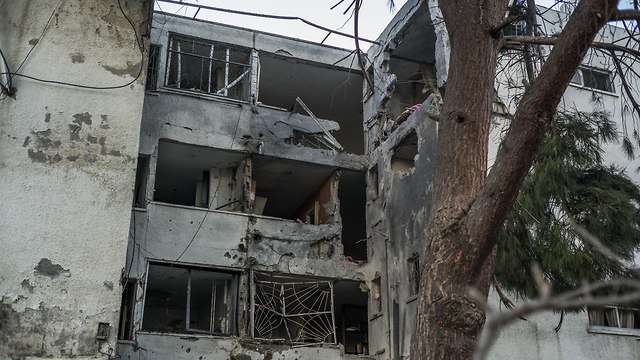 |
| Building hit by rocket in Ashkelon (Photo: MCT) |
Even though Israel bombed over 160 targets in the Gaza Strip, including a high rise building being used as the Hamas Security HQ and a Hamas-run TV station, there are no reports of civilian fatalities there. This is because Israel tries to avoid civilian casualties by warning of attacks ahead of time, giving people time to leave targeted areas. Messages are sent to people's cellphones, leaflets are dropped and warning 'knock' bombs dropped leaving time for people to flee before the real bombs hit. What other army in the world would do this???
Hamas, in contrast, targets civilian towns and cities aiming to cause as many civilian deaths as possible. Some tens of rockets hit residential areas in Israel. One of the Hamas rockets landed in a kindergarten, totally destroying it. Fortunately, the schools and kindergartens had been closed down because of the bombardment and there were no children or staff in the kindergarten at the time. Other rockets destroyed several homes, a minimarket and a factory. At the factory, shrapnel punctured a large tank containing gas, which burned fiercely for about 12 hours threatening buildings nearby. Residents in the Gaza Perimeter were warned to stay in their bomb shelters during this period and this saved many lives.
Although the shelling of Israeli civilian communities was severe it was limited to the 40 km Gaza Perimeter zone. It seems that Hamas is no more interested at this time in a full-scale war, which it could only lose, than Israel. They are much more interested in waging a propaganda war, undermining Israel in many ways. This is a war they are very skilled at and indeed seem to have the upper hand. Their media is not shy of twisting the truth, manufacturing fake incidents and using graphic images of civilian casualties to gain points. The Israeli media is much more ethical and sensitive in its reporting and is therefore at a disadvantage when it comes to influencing public opinion around the world. It is for this reason that Israel destroyed the Hamas-run TV station. It only took a few hours however before the TV station was reporting from another site.
The ceasefire has now lasted for over 3 days but the situation is tense. The uneasy quiet could be shattered any moment and the feeling is that the next round could be catastrophic, both for Israel and for the civilians of Gaza.
This latest round of aggression has caused a major political upset in Israel. A large majority of Israelis, some 74% according to polls, are angry with the Netanyahu government for accepting the ceasefire. Frustration with the seemingly endless rounds of rocket fire from Gaza into southern Israel, and the reluctance of our government to allow the security forces to deal with it once and for all, is beginning to boil over. Residents of the southern communities most affected have had enough and have been demonstrating in various places around the country joined by many supporters.
A deep rift has opened up in the coalition government after Defense Minister Avigdor Lieberman resigned from his position in protest of Netanyahu's acceptance of the ceasefire. This means that now Netanyahu's coalition government has a majority of only one seat in the Knesset, an untenable position. Netanyahu is insisting that he himself should take up the Defense Minister's role as well as his current roles as Prime Minister and Foreign Minister. This seems symptomatic of his lack of faith in his own government colleagues, either that or he is suffering from some measure of megalomania. Opposition to Netanyahu's intention is causing others to question their loyalty to the current government too. New elections have been announced, but the date for them has not yet been set. This instability in government at such a crucial time leaves Israel vulnerable, a situation that is not escaping the notice of Hamas.
While Israelis rage, the people of Gaza are celebrating their 'victory' over Israel in the latest round. This too is dangerous and could precipitate them into a reckless act. Yesterday, Friday, the Hamas chief, Yahya Sinwar, brandishing a gun, while speaking at a ceremony to honor the 7 Hamas soldiers killed, warned Israel " not to test us again” saying the next rocket barrage from the territory would target Tel Aviv and other central cities with a potency that would “surprise” Israel (2). He went on to say that he had spoken to the leader of the Hamas military wing, Muhammad Deif, who had asked him to say that "Tel Aviv and Gush Dan (the greater Tel Aviv area) are next. The first barrage to hit Tel Avi will surprise Israel." Sinwar also mocked Israel for assuming its decision to allow fuel and Qatari funds into Gaza would prevent his group from launching a large-scale attack against Israel. He said ".
“What did the Israeli leadership think when it allowed in fuel and Qatari funds? … That we would sell out our blood for diesel and dollars? They’ve been disappointed, and their goals have failed” (2). He also warned that the next time Israeli soldiers entered the Strip they would only return to Israel in exchange for thousands of prisoners, a clear threat of their intention to capture hostages.
 |
| n this November 16, 2018 image, Hamas's Gaza chief Yahya Sinwar holds up a handgun with a silencer he says was captured from Israeli special forces during a firefight in the Gaza Strip on November 11 (YouTube screenshot) https://www.timesofisrael.com/hamas-gaza-chief-to-israel-dont-test-us-again-next-barrage-will-hit-tel-aviv/ |
With such talk there is a sense here that the 'next round' is not only inevitable but imminent. It is likely that Hamas only called for ceasefire now in order to receive the funding from its ally Qatar to enable it to further prepare for 'the next round'. This funding was part of the Truce Agreement brokered by Egypt and the UN.
If Hamas attacks Tel Aviv and the surrounding heavily-populated Gush Dan region there is likely to be massive loss of life. Unlike the southern communities, the central cities of Israel are not as well equipped with bomb shelters and nor are their citizens as well-drilled in how to behave when the sirens go off. Many homes do not have bomb shelters and the public shelters are far apart and few, too distant to be of much use to most people. Once the sirens sound there are only 1-2 minutes to find shelter. An attack on the economic center of Israel, the air and sea ports, and industrial centers would have a severe impact on the economy.
According to Netanyahu, he agreed to the ceasefire because he did not want Israel to be dragged into a war because of a botched intelligence incident. He said it is better to wait until we have a clear moral mandate and military readiness to launch a confrontation. I can see his point but I also fear that 'he who hesitates' may be lost. I think the real reason for our hesitation may lie in the fact that we do not have a policy regarding 'the morning after'. No one doubts that Israel outguns Hamas and would eventually win such a war in the military arena, albeit with massive loss of life on both sides, however no one has any idea what we could do next. Israel does not want to occupy Gaza. Egypt, who once did, no longer wants to control Gaza. The Palestinian Authority wants to control Gaza but lacks the stability and resources to do so, and Jordan is not interested either. Who would rule Gaza if Hamas is destroyed? It might be the situation of casting out one demon but just leaving the door open for many other demons to come in. War seems like a lose-lose situation both for Israel and the Gazan people. Yet it seems inevitable in view of the rhetoric coming out of Gaza and its threats against Israel. I don't know how long the Netanyahu government, as shaky as it is, can hold out against the anger of the general population of Israel either. But, could we even fight a war without a strong government? There is also the risk of a second or third front opening up in the north at the same time. Could we fight against Iran, Hezbollah, Lebanon and Syria while being bombarded by Hamas in the south? Such a scenario is too horrific to be contemplated.
I am grateful my peace of mind does not depend upon men. With men there is no hope. But with God all is possible. He has a just and good solution to this problem. I don't know what it is yet, but I believe that in time it will be revealed. I hold on to the prophecy that one day Gaza will belong to Judah:
In the day of the Lord’s anger. For Gaza shall be forsaken,...The seacoast shall be pastures,With shelters for shepherds and folds for flocks.7 The coast shall be for the remnant of the house of Judah;
Zephaniah 2: 3-4, 6-7
I, for one. will put my trust in the Lord to fulfill his word. Pray that many in Israel will call out to the LORD at this time.
Praise the Lord, O my soul!
While I live I will praise the Lord;
I will sing praises to my God while I have my being.
Do not put your trust in princes,
Nor in a son of man, in whom there is no help.
His spirit departs, he returns to his earth;
In that very day his plans perish.
Happy is he who has the God of Jacob for his help,
Whose hope is in the Lord his God,...
Psalm 146: 1-5
References:
2. https://www.timesofisrael.com/hamas-gaza-chief-to-israel-dont-test-us-again-next-barrage-will-hit-tel-aviv/


